
When planning for your herds’ genetic future, there are multiple points to consider to maximize genetic progress and capitalize on the valuable beef‑on‑dairy calf market.

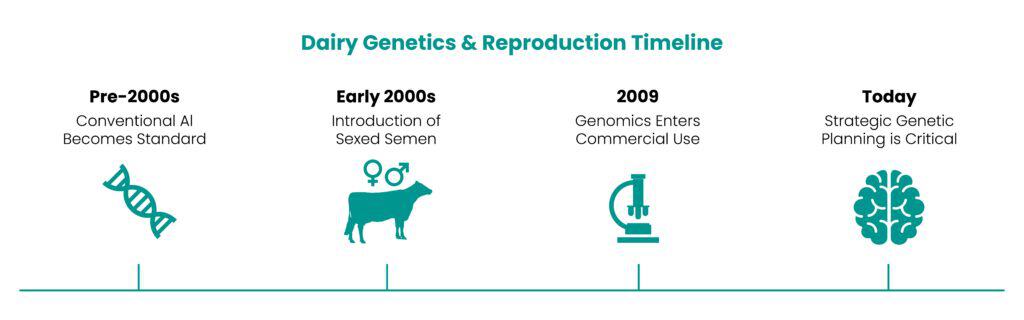
For many of us, it seems like just yesterday when we shifted our breeding strategy from using herd bulls to breeding all our cows and heifers with the same straws of conventional dairy semen. Although this proved to be a significant advantage, it didn’t hold a candle to the early 2000’s when sexed semen was introduced to the market. Not only did conception rates improve, but we now had the technology to increase heifer ratios from a single breeding. Fast forward to 2009 when genomic testing became available, an advancement with rapid and impactful results. The artificial insemination (A.I.) industry saw increased accuracy in genetic evaluations, moving genetic progress forward at an expedited rate. With the introduction of genomics traits — such as milk production and
component yield — improved progress even faster but additionally, a newfound light was shown on other areas of focus including fertility and health traits. This opened the door for healthier, more profitable cows to be produced faster.
Although the industry has achieved rapid genetic advancement, with today’s competitive market, return-on-investment (ROI) is imperative. Here are several steps to consider when planning your herd’s genetic future for the best possible return on investment.
1. Evaluate future heifer inventory needs
Due to rising production costs, it’s critical for herds to correctly size their heifer population, avoiding unnecessary rearing costs. When determining future heifer inventory needs, you should consider your cull rate and future expansion plans. Other factors to consider are reproductive performance, age at first calving, calf death losses, heifer rearing loss and heifer cull rates. A herd with higher reproductive efficiency can breed fewer cows while achieving the same number of pregnancies as a herd with lower conception rates. Once an annual or monthly target of required replacements is established, consider adding a buffer of 5-10% to account for fluctuations and unforeseen circumstances.
2. Maximize beef-on-dairy profitability
It’s no secret that we’ve seen record beef-on-dairy calf prices in the U.S. over the past several months. Although most farms have already incorporated beef semen into breeding strategies to reap the financial benefit, it’s also an opportunity to reduce excess heifer inventory. With continued high calf values predicted, it’s important to regularly reassess your beef-on-dairy strategy. Are these calves being marketed as day-olds, or are you retaining ownership and selling them later down the line? If you’re looking to capitalize on the day-old market, the calf value at pickup is the main driver. In this scenario, consider partnering with a guaranteed buyer program to ensure reliable calf pick-up.
In a herd looking to retain ownership, beef semen genetics becomes another important factor to maximize growth and performance. Sexed male beef semen makes sense in retained ownership scenarios, since male calves generally have better market value and higher average daily gain than heifers.
Regardless of market strategy, do your fertility homework when choosing a beef-on-dairy genetic partner. A 5% difference in conception rate can result in 50 more beef-on-dairy calves sold annually for a 1,000-cow dairy.
3. Determine herd genetic goals
To make meaningful genetic progress, you should have key metrics in place to measure and benchmark against. This is where having a herd genetic goal becomes important. To start, work with your genetic provider to conduct a genetic audit. Genomic testing provides the most accurate data; however, parent average can also be used to determine herd genetics. Evaluate which traits need improvement and which should be maintained. Indexes effectively combine several traits together while accounting for naturally occurring genetic correlations. Choose an index that aligns with your milk market and prioritizes economically important traits. As a producer, you can choose to use a commercially available index or a custom-built index for your farm. Avoid changing your herd genetic goal frequently, since that will make it difficult to measure meaningful progress.
4. Execute a semen distribution strategy
Finally, determine your semen distribution strategy and execute it. The goal is to get the highest genetic value sexed semen into the highest genetic value females. On the contrary, the lowest genetic value females should be bred to beef semen. If genomic testing, use the results to determine the semen product based on the chosen index. Lactation number and times bred can also determine which semen product to use. In this scenario, the youngest animals would receive the most services of sexed semen and later lactation cows would receive beef semen. Compliance with the breeding plan is key. Review regularly to ensure the breeding team is not drifting from the strategy, and replacement heifers are being produced from the best females in the herd.
Treating every female in the herd as genetic equals sets us up to miss the opportunity to maximize genetic progress. With currently available tools, you can keep heifer raising costs in line while still capitalizing on the extra value of beef-on-dairy calves.
Today’s breeding decisions ultimately affect your herd’s calving next year, with those females entering production two years later. Maintaining sharp focus and a steady approach is critical. Be sure to monitor genetic progress on an annual basis with tangible values. Resist the urge to deviate from your plan based on market volatility. A solid, consistent plan drives lasting profitability in your herd.